
Criminal Cases in the Wilkes County Courts
Wilkes County criminal court cases are filed with the North Carolina Judicial Branch in District 34. District Court handles misdemeanors as well as felony first appearances and preliminary steps. Superior Court tries felonies and handles indictments, felony pleas, judgments, and sentences. Both courts sit at the Wilkes County Courthouse. The division shown on a docket matters because a felony can begin in District Court and later move to Superior Court.
The Clerk of Superior Court is the custodian for both levels. The clerk maintains Wilkes County case numbers, filed charges, hearing events, orders, dispositions, judgments, sentences, probation entries, and financial obligations. A police report or jail booking is not a substitute for that file. It captures an earlier stage. For an official outcome, match the person and case number, then read the disposition for each charge.
The official Wilkes County courts page shows the county court services and calendars.
That county landing page is the safest starting point for current court notices and criminal calendars.
Wilkes County Felony Case Path
A Wilkes County felony case can appear under more than one stage of court work. The first appearance and preliminary matters occur in District Court. If the charge proceeds by indictment, the felony record then moves through Superior Court. That shift does not mean there are two unrelated arrests. Compare the party, event dates, charge, and case number before drawing a conclusion.
Misdemeanors normally remain in District Court. Yet even one Wilkes County criminal case can contain several charges with different results. One count may be dismissed while another ends in a plea or trial judgment. Read every charge line. A broad status such as “closed” describes the case as a whole and does not, by itself, mean every count produced a conviction.
The Wilkes County Courthouse profile identifies the court building, access hours, parking, and services.
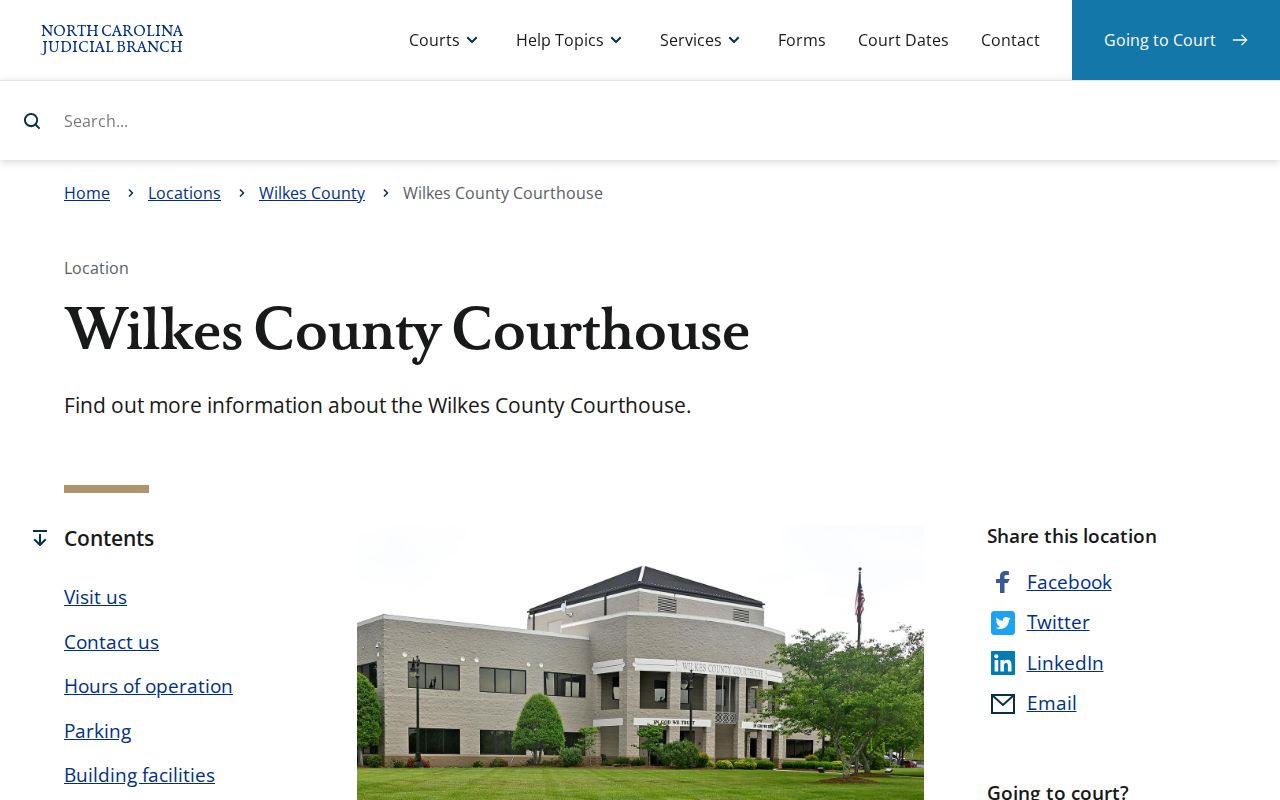
This is the physical record hub for District and Superior Court files in Wilkes County.
How to Search Case Records
The North Carolina eCourts Portal provides free public case information. Wilkes County is part of the statewide Enterprise Justice, also called Odyssey, system. A name can produce leads, but a case number is a stronger key. Use Wilkes County as the location and criminal as the category when those live controls are offered. Dynamic labels can change, so follow the current screen rather than relying on an old list of dropdown choices.
- Open Smart Search in eCourts Portal and choose the criminal case area when the interface offers that option.
- Enter the full party name or known case number. Check spelling and name order.
- Narrow the result to Wilkes County, then use case type, status, or date filters shown on the live screen.
- Open the docket and compare the court, filing date, charge lines, events, status, and disposition.
- Ask the Wilkes County clerk for unavailable documents, certified copies, or help with an older or unclear file.
The Wilkes County portal search supports several verified concepts. Not every control is mandatory, and the Judicial Branch does not publish every live menu value.
| Field Label | Type | Required | Notes |
|---|---|---|---|
| Search Type / Smart Search | Selector | Unspecified | Supports party name, case number, attorney, and other current search concepts. |
| Search Criteria | Text | Unspecified | Enter a person, business, attorney, or case number as live help permits. |
| Advanced Filters | Expandable | No | May narrow by location, case type, status, or other exposed fields. |
| Location | Dropdown | No | Select Wilkes County to reduce same-name results from other counties. |
| Date Range | Date controls | No | Useful when the filing year or event period is known. |
The official eCourts overview explains the statewide platform and its current services.
Its statewide scope helps distinguish a Wilkes filing from a case attached to the same name elsewhere in North Carolina.
Wilkes County Certified Case Search
Portal results are not the Judicial Branch's certified background product. For a certified Wilkes County name search, submit form AOC-CR-314 to the Clerk of Superior Court. The fee is $25, and the result covers court records in Wilkes County only. It is not a statewide fingerprint history.
The form asks for the county, full name, date of birth when known, identifying descriptors, requester contact information, the requested certification or copies, and a signature and date. Mail requests require a money order or certified check, not a personal check. At the counter, the Judicial Branch lists cash, credit card, money order, or certified check. The Wilkes County payment page controls current payment instructions. A courthouse public terminal is the free, noncertified alternative and can provide statewide searching or emailed results. Printing may cost extra.
The official criminal record search form controls the current fields and submission terms.
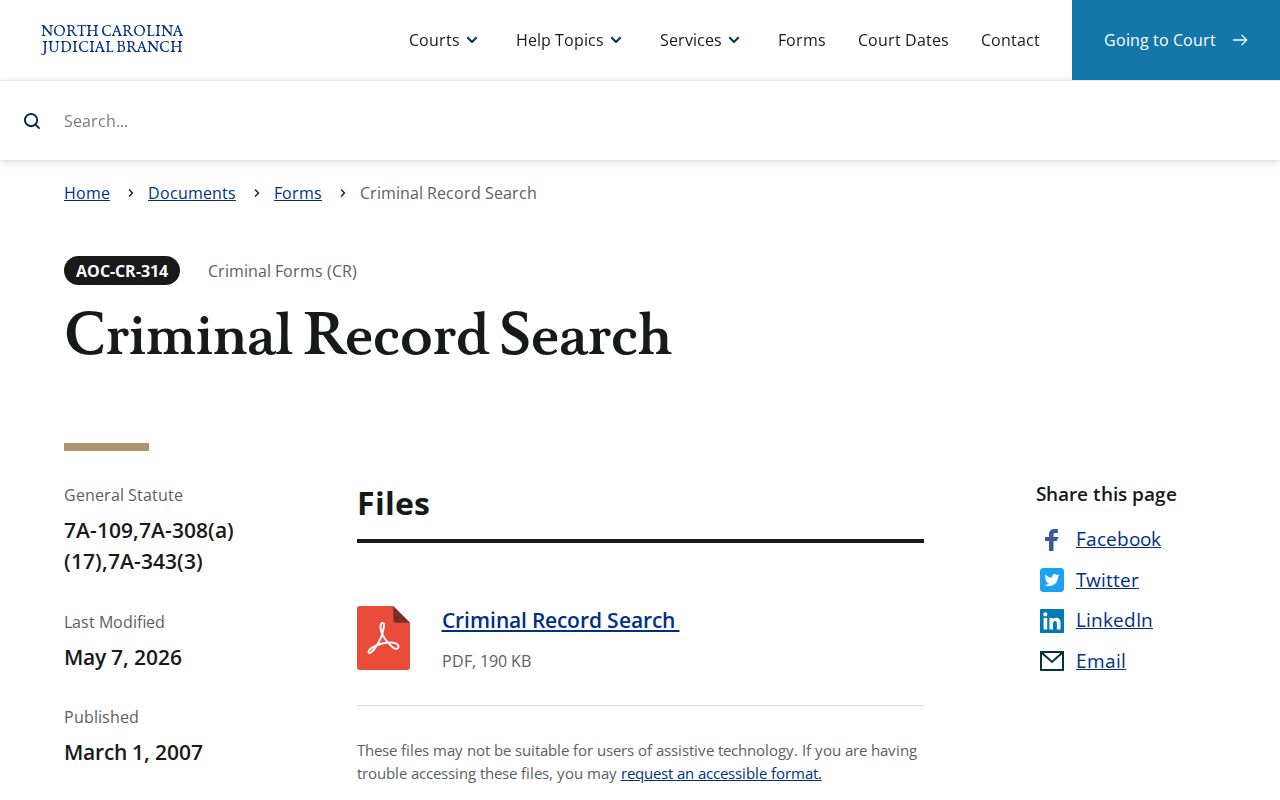
This form is useful when a certified, single-county court search is required instead of an informal portal review.
What the Case File Shows
A Wilkes County criminal case file tracks judicial action after a charge reaches court. Portal views of Wilkes County cases may show many of these fields, while the clerk file can hold the filed documents and orders that are not available online. Availability varies by document and access rule.
| Case Number & Court | Identifies the Wilkes filing, location, and District or Superior Court division. |
|---|---|
| Charging Document | Shows the charge actually filed in court, which may differ from the intake charge. |
| Docket Entries | Records events such as process, motions, continuances, pleas, orders, and appeals. |
| Hearing Dates | Lists scheduled sessions, courtroom information, and related calendar events when public. |
| Disposition & Judgment | States the result for each count and the date of that result. |
| Sentence & Conditions | May show custody, probation, financial obligations, and later violation activity. |
Identity deserves care. Match more than a name. Confirm Wilkes County, the case number, dates, charge, and other lawful identifiers. A financial balance does not state the disposition, and a calendar entry is only a schedule. For the larger criminal-record context, the Wilkes County criminal history overview explains how clerk, sheriff, jail, and SBI records answer different questions.
Wilkes County Mixed Case Results
One Wilkes County case can carry several counts. Do not assign the result of one count to all the others. Read each charge description, statute reference, level, status, disposition, and disposition date. A prosecutor may amend a charge, dismiss one count, and proceed on another. The final judgment, not the earliest label, provides the court's outcome.
Common event categories include a complaint or process issuance, first appearance, probable-cause setting or waiver, indictment, arraignment, motions, continuances, plea, trial, dismissal, judgment, sentence, probation order, appeal, and violation or revocation activity. Portal labels remain system-controlled. If the sequence is unclear, ask the clerk to identify the public file or order that resolves it.
- Status
- The present state of a case or count, such as pending or closed, not the result by itself.
- Disposition
- The formal result attached to a particular charge, with its recorded date.
- Judgment
- The court's formal decision after a plea, trial, or other final action.
- Revocation
- A later court action that can change probation after a violation proceeding.
Wilkes County Criminal Case Calendars
A criminal calendar answers when and where a Wilkes County case is set for a court session. It may list the defendant, session date, courtroom, county, case number, and charge. That snapshot does not carry the full procedural history. A setting can move, and the calendar does not prove how the charge ended.
The docket and clerk file answer the larger question. They track filed events, each charge's status, orders, disposition, judgment, and sentence. Start with the official Wilkes criminal calendars when locating a coming appearance. Use eCourts or the clerk's case file to understand what has already happened. Comparing these sources prevents a scheduled hearing from being mistaken for a final result.
Stages of a Criminal Case
A Wilkes County criminal court case begins once a charge is filed, though an arrest and booking may occur first. District Court handles a misdemeanor path and the early felony steps. An indictment can move a felony into Superior Court. Motions, continuances, pleas, and trials become docket events. The case then reaches a disposition for each count. If guilt is found or admitted, the judgment sets the sentence under the applicable felony or misdemeanor framework and any terms of probation. Later appeals or violation proceedings can add new entries.
Case flow: Charges Filed › Arraignment › Pretrial › Plea or Trial › Disposition › Sentencing
No fixed Wilkes County timetable is published for each phase. Calendar settings, continuances, the type of charge, and court orders affect pace. Use the current docket and official calendar rather than estimating a result date.
Missing Wilkes County Case Records
An empty eCourts search does not prove that no Wilkes County criminal case exists. Check spelling, name order, location, case type, and date filters. Try the case number if known. A matter may also be too old for the expected online view, recently filed, sealed, expunged, juvenile, or indexed in a way that a broad name search misses.
The next stop is the Clerk of Superior Court at 500 Courthouse Drive, Wilkesboro, NC 28697, 336-651-4400. Public terminals are available at courthouses, and the clerk can explain copy or certification options for a public file. The Wilkes court contact directory also lists the clerk, judges, District Attorney, and magistrate channels.
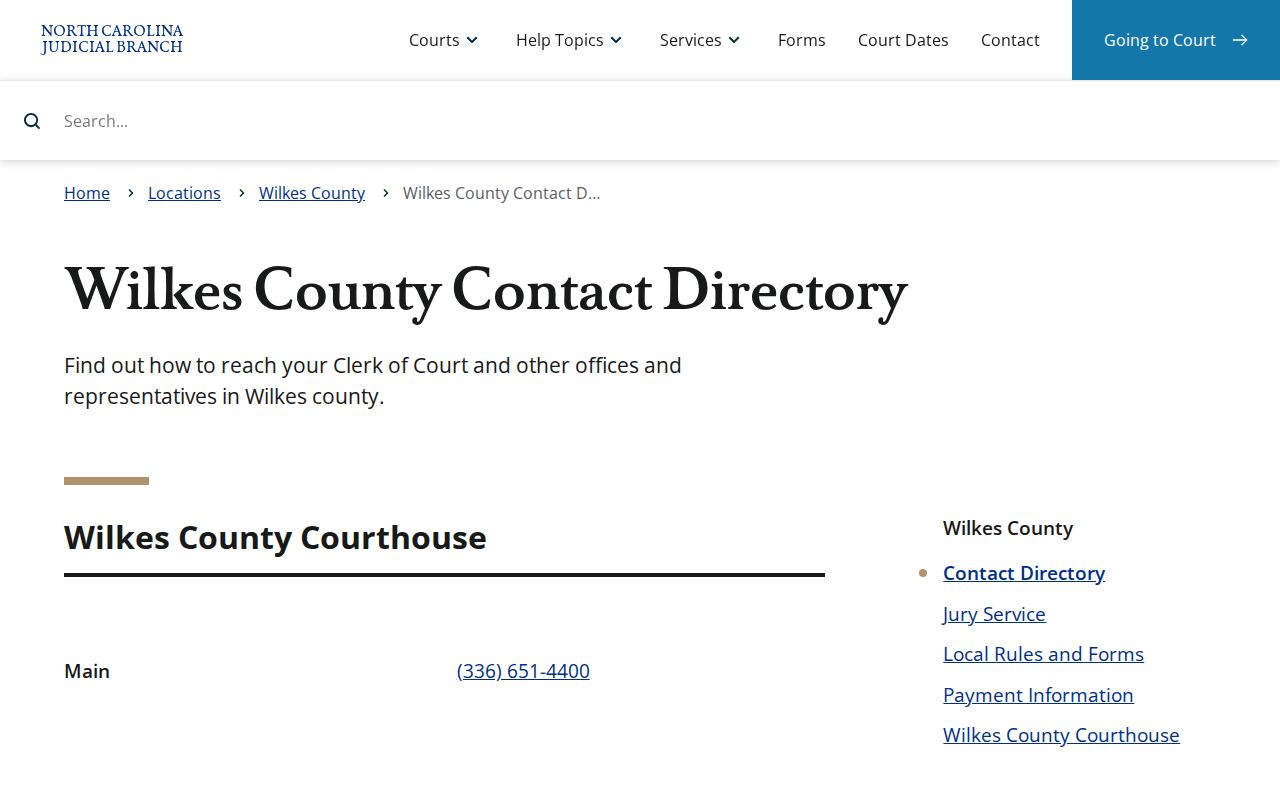
Using the right office avoids sending a case-file question to the jail or sheriff's report counter.
Access & Restrictions
North Carolina Public Records Law begins with broad public access, but criminal records have specific limits. Chapter 132 governs inspection and copies at reasonable times. Court files remain subject to sealing, expunction, victim protection, identity redaction, and separate juvenile rules. A certified name search is a defined clerk product, not a right to every document in a file.
Remote access can be narrower than access at the Wilkes County clerk's counter. Public case information does not guarantee that every filed document can be downloaded. When a document is unavailable, ask the clerk whether it is public at the courthouse, redacted, confidential, sealed, or absent from the case. Name the exact item and case number. That gives staff a clear request and helps separate a technical portal limit from a legal restriction.